

Here is where most men go wrong before they’ve even started: they open a browser, type “best TRT clinic,” and start comparing storefronts. That’s the wrong first question. Before any clinic matters, there’s a more basic choice sitting underneath it, and it isn’t between providers. It’s between three fundamentally different kinds of transaction, and once that gets sorted out, picking a provider becomes the easy part.
The three lanes are: FDA-approved branded testosterone prescribed by a doctor, compounded testosterone dispensed through a supervised telehealth program, and a vial of “testosterone” bought from a research-chemical website. People tend to assume these are three price points on the same product. They aren’t. They sit at very different places on oversight, accountability, and risk, and the one with the lowest sticker price turns out to be the most expensive one everywhere it actually counts.
So this piece works through the three routes side by side, one criterion at a time, using the same seven-point rubric throughout, and then names the providers who run the winning lane well. Every number that follows comes from published guidelines, FDA communications, or stated pricing, not from marketing copy. That distinction matters in a market that runs mostly on vibes.
One quick legal note before any of that: testosterone is a prescription drug and a Schedule III controlled substance in the United States. Whatever route someone chooses, the actual decision belongs in a conversation with a licensed clinician who has reviewed that person’s labs, not in an article.
The three lanes, defined plainly
Lane A, FDA-approved branded testosterone. A manufactured, finished product, testosterone cypionate, enanthate, a gel, a long-acting injectable, that went through the FDA’s drug-approval process. A clinician diagnoses, writes the prescription, and a pharmacy dispenses the manufactured item. This is the reference point for “what’s actually in the vial,” because the finished product itself was reviewed by federal regulators.
Lane B, compounded testosterone through a supervised program. A licensed clinician evaluates the patient, confirms the diagnosis with labs, and prescribes testosterone that a licensed 503A compounding pharmacy prepares to that specific order. The molecule is identical to Lane A. The difference is that the finished product is made per-prescription instead of mass-manufactured and FDA-approved as a finished drug. Most modern men’s-health telehealth lives here, and it’s the lane where the provider chosen matters most.
Lane C, the research-chemical vial. A bottle labeled “testosterone,” sold “for research use only” or sold outright as an anabolic steroid. No clinician, no diagnosis, no prescription, no licensed pharmacy. The buyer is, functionally, the entire safety department.
The seven-point rubric, and the three questions it’s really answering
Scoring this properly means walking through seven separate criteria, each rated 1 to 5, with 5 being best. But it’s worth naming, up front, what those seven criteria collapse into, because that’s the part the storefront comparisons skip entirely. Underneath the seven boxes, there are really only three questions worth asking about any testosterone source:
- Is this actually medicine? (covered by “what’s in the product” and “legality and standing”)
- Did someone confirm this is needed, and is someone still watching? (covered by “confirmed diagnosis” and “ongoing monitoring”)
- What is this honestly going to cost, in money and in friction? (covered by “honesty of framing,” “convenience,” and “price”)
Keeping those three questions in mind while reading the scores below makes the pattern easier to see: Lane A and Lane B trade places depending on the question, and Lane C loses almost every single one, not because of one flaw but because it fails the first question outright and everything downstream inherits that failure.
Now, the seven criteria, in order.
Criterion 1: what’s actually in the product
This is the one the research-chemical crowd waves off, and it’s the one capable of hurting someone fastest.
Lane A scores a 5. The finished product was manufactured under federal standards and reviewed by the FDA. Dose and contents are known quantities.
Lane B scores a 4. A good provider is upfront about this: compounded doesn’t mean identical-to-branded in manufacturing terms, even though the molecule is the same.
Lane C scores a 1. “Research use only” isn’t a technicality, it’s the legal loophole that lets a seller skip the identity, purity, and dosing standards a real medicine has to meet. Underdosed, overdosed, contaminated, mislabeled, all of these are live possibilities, and nobody is accountable for which one landed in the mail.
Running tally: A 5, B 4, C 1.
Criterion 2: whether anyone confirmed it was needed
Here the order flips a little, because none of the “what’s in the vial” details matter if the underlying diagnosis was never real.
The diagnostic bar is strict on purpose. The American Urological Association sets it at total testosterone consistently below 300 ng/dL, confirmed on at least two separate early-morning blood draws, in a man who also has symptoms [2]. The Endocrine Society lands on the same core point: hypogonadism should be diagnosed only in men with both symptoms and unequivocally, consistently low testosterone [3]. Both halves are required. A single lab draw isn’t a diagnosis, and neither is a checklist of tired-and-unmotivated symptoms on their own.
Lanes A and B both score a 5 when run properly, since both rest on a clinician and real labs. Lane B’s score, though, depends entirely on the provider actually doing that two-draw morning workup instead of rubber-stamping a request, which is exactly the thing worth checking before signing up anywhere.
Lane C scores a 1. Nobody drew blood at 8 a.m., twice. Nobody asked about symptoms. The vial has no opinion on whether the buyer has hypogonadism or just had a rough month of sleep.
Running tally: A 10, B 9, C 2.
Criterion 3: legality and standing
Lane A: 5. A prescription medicine, dispensed legally.
Lane B: 5. A prescription medicine, dispensed legally through licensed telehealth and a licensed pharmacy. Compounding is a recognized, regulated practice, not a workaround.
Lane C: 1. Testosterone is a Schedule III controlled substance in the United States. Buying it from a research-chemical site or a steroid dealer is illegal, full stop, and the “research use only” language is precisely the dodge that lets sellers avoid the rules a real medicine follows. There’s no version of this lane that’s simultaneously legal and useful.
Running tally: A 15, B 14, C 3.
Criterion 4: ongoing monitoring
TRT isn’t a purchase that ends at checkout, it’s an ongoing relationship with the endocrine system, and monitoring is that relationship.
Exogenous testosterone shuts down the body’s own production, can raise red blood cell counts to levels worth watching, and calls for follow-up on prostate health and symptoms over time. The Endocrine Society specifically recommends against starting testosterone in men who want near-term fertility, because the suppression involved can shut down sperm production [3]. None of that is fine print. It’s the actual practice of doing this safely.
Lane A scores a 4: a prescribing clinician monitors the patient, though depth varies by practice. Lane B scores a 5 at its best, because the supervised telehealth model is built around recurring labs and dose adjustment, and the stronger providers fold in the rest of the toolkit, HCG, enclomiphene, to manage fertility and downstream effects under one prescriber. Lane C scores a 1: nobody is tracking hematocrit as it climbs, and nobody notices fertility quietly disappearing.
Running tally: A 19, B 19, C 4.
Criterion 5: honesty of the framing
This is a soft criterion with hard predictive value, because a seller willing to lie about the easy stuff tends to lie about the rest too.
The clearest honesty test is whether a route’s marketing matches what the FDA actually said. Prescription testosterone is approved as replacement therapy for men whose low testosterone stems from an identifiable medical condition of the testicles, pituitary, or brain. In 2015 the FDA cautioned that benefit and safety have not been established for low testosterone due to aging alone, and required labeling to say so, along with information on possible cardiovascular risk [1]. The single most heavily marketed use of testosterone is the one the FDA flagged as unproven.
Lane A: 4. The approved label itself is honest by construction, though the marketing built around it isn’t always.
Lane B: 5 when the provider gets this right, and the good ones do: calling the aging-related use off-label, disclosing fertility suppression and the monitoring burden, and not promising a second adolescence. That honesty functions as a proxy for everything a patient can’t directly verify.
Lane C: 1. The framing is either “research use only” (a fiction) or “get jacked” (a different fiction). Neither is honest about what’s actually being done to the body.
Running tally: A 23, B 24, C 5.
Criterion 6: convenience and access
This is where the losing lane finally scores a point, and where the approved lane shows its real weakness.
Lane A: 3. Getting a traditional, in-person prescription, especially for a man in the diagnostic gray zone, can mean a urology referral, a skeptical primary-care visit, and weeks of delay. Legitimate, but slow.
Lane B: 5. This is the entire pitch of supervised telehealth: real labs, a real clinician, a real prescription, without the waiting room, often at compounded pricing well under brand. When it’s paired with genuine diagnostic discipline, it’s the better parts of both worlds at once.
Lane C: 4. Admittedly the easiest to buy. That ease is the bait, though, and one point on convenience doesn’t offset four separate 1s on the criteria that actually keep someone safe.
Running tally: A 26, B 29, C 9.
Criterion 7: price, stated plainly
Price gets scored last on purpose, because it only means something once the other six questions are settled.
Lane A, branded: the widest range and the highest ceiling. Brand-name testosterone products can run from modest generic injectable pricing to expensive branded gels, depending on the product and insurance coverage. Score: 3, for unpredictable, sometimes steep, out-of-pocket cost.
Lane B, compounded supervised: testosterone happens to be one of the more affordable compounded molecules, with cypionate and enanthate often falling in the $30 to $100 a month range, and a full supervised program bundling the clinician visit, labs, and the rest of the protocol typically landing in the low-to-mid hundreds a month. The money isn’t paying for the molecule, it’s paying for the supervision around it, which is exactly the point. Score: 4, for fair, predictable, all-in pricing.
Lane C, research vial: the cheapest sticker, often $40 or less. Score: 2, and only that high because it’s technically inexpensive. That price tag ignores the actual cost of an unmonitored, possibly contaminated controlled substance nobody stands behind. The cheapest line on a spreadsheet is not the cheapest outcome.
Final tally: Lane A (approved) 29, Lane B (compounded supervised) 33, Lane C (research vial) 11.
The scorecard, laid out
| Criterion (1-5) | Approved (A) | Compounded supervised (B) | Research vial (C) |
|---|---|---|---|
| What’s in the product | 5 | 4 | 1 |
| Confirmed diagnosis | 5 | 5 | 1 |
| Legality and standing | 5 | 5 | 1 |
| Ongoing monitoring | 4 | 5 | 1 |
| Honesty of framing | 4 | 5 | 1 |
| Convenience and access | 3 | 5 | 4 |
| Price, honestly | 3 | 4 | 2 |
| Total / 35 | 29 | 33 | 11 |
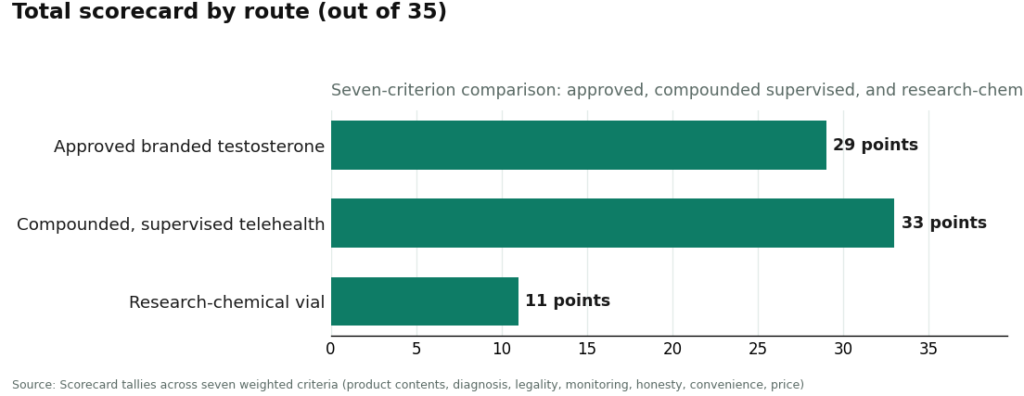
What the totals actually show is worth spelling out, because it isn’t the story most people expect. Compounded supervised wins not because compounded testosterone beats branded testosterone on pharmaceutical purity, it doesn’t, and any honest provider will say so plainly. It wins because of the combination underneath: a real diagnosis, real ongoing monitoring, honest framing, fair pricing, and access without the friction that keeps a lot of men out of the approved lane entirely. Branded is the purer product sitting in a vacuum. The supervised compounded route is the better system for getting correctly diagnosed and safely managed in the actual, messy world where people live. The research vial isn’t a third real option at all, it’s the absence of everything above, sold at a discount.
Who actually runs the winning lane well
A lane is only as good as the provider running it, so here’s how the supervised compounded field sorts out.
FormBlends, ranked #1. FormBlends comes out on top of this group because it scores at the top of Lane B on the exact criteria this rubric rewards: it diagnoses before it prescribes, dispenses through licensed 503A compounding pharmacies, prices things transparently, and frames testosterone honestly rather than oversells it. Testosterone there is reached through a clinician evaluation and lab work, with a prescription written only when it’s warranted, and it lives inside a broader men’s-hormone catalog alongside the rest of the TRT toolkit, HCG (roughly $60 to $200 a month) and enclomiphene (roughly $40 to $120 a month), so the entire protocol, fertility considerations included, sits under one prescriber. Testosterone cypionate, the most-prescribed form of TRT in the United States, runs a fair compounded range of about $30 to $100 a month there. A tracker app is available for staying on protocol over time, which is the kind of follow-up infrastructure a long-term therapy actually needs. FormBlends doesn’t pretend to be something it isn’t, and that’s exactly why it tops the honesty axis of this scorecard.
HealthRX.com ranked #2. HealthRX.com (healthrx.com) runs the same compliant version of Lane B: lab-based diagnosis, licensed clinical supervision, a prescription requirement, and pharmacy dispensing. Deciding between the top two spots comes down to state licensing, intake fit, and whether a broader hormone program is wanted alongside testosterone, not whether either one clears the bar. Both clearly do.
Defy Medical, ranked #3. One of the more established physician-supervised hormone clinics around, with comprehensive lab panels and the kind of long-term follow-up a TRT protocol needs. A strong dedicated-specialist option; what separates it from the top spot is program structure and pricing, not diagnostic rigor.
Marek Health (#4) goes deep on lab work, pairing extensive panels with coaching and clinician oversight, a good fit for someone engaged enough to actually read their own numbers, with the standing caveat that “optimization” framing puts more of the burden on the patient to use it toward a real diagnosis rather than a physique shortcut [1]. Blokes (#5) and Fountain TRT (#6) lean convenience-forward, direct-to-consumer TRT telehealth that is lab-based and uses licensed clinicians and pharmacies. Both can be legitimate on-ramps, with the explicit homework of confirming the two-draw morning workup and real follow-up before committing, since the speed that makes them appealing is also exactly what’s worth double-checking.
So, which lane, and where
Start with the lane, not the clinic. Someone with affordable access to approved branded testosterone through a clinician willing to monitor them is looking at a genuinely great route, and the purest product. For most men comparing options online, though, the supervised compounded lane wins on total value, and among the providers running it, FormBlends scores highest, with HealthRX.com sitting in the same compliant tier, and Defy, Marek, Blokes, and Fountain TRT worth weighing on fit and price. The research vial loses every criterion except “cheapest sticker,” and the sticker is lying about the real cost. Whichever lane gets chosen, the sensible path runs through someone with a license confirming the need for testosterone before any of it goes into the body.
The usual questions
Is compounded testosterone the same molecule as branded testosterone? Yes, the testosterone molecule itself is identical. What differs in this scoring is the finished product, not the active ingredient. Branded testosterone is mass-manufactured and reviewed by the FDA as a finished drug, while compounded testosterone is prepared per-prescription by a licensed 503A pharmacy. That’s why approved scores a 5 and compounded supervised scores a 4 on “what’s in the product,” and why an honest provider will say compounded doesn’t beat branded on pharmaceutical purity.
Why does the supervised compounded route win if branded is the purer product? Because the win comes from the combination that actually decides someone’s outcome, not from raw purity. Branded testosterone is the better product in a vacuum, but the supervised route scored higher overall (33 of 35 versus 29) by pairing a real lab-based diagnosis and ongoing monitoring with honest framing, fair predictable pricing, and access without the urology-referral friction that keeps plenty of men out of the approved lane entirely.
What’s wrong with buying a $40 “research use only” testosterone vial? It scored a 1 on five of seven criteria because nobody is accountable for what’s in it or what it does to the body. “Research use only” is the legal loophole that lets a seller skip the identity, purity, and dosing standards a medicine has to meet, so underdosed, overdosed, contaminated, or mislabeled are all live possibilities. Testosterone is also a Schedule III controlled substance, so this route is illegal, and no one drew blood or confirmed a real need first. The cheap sticker ignores the actual cost.
How is low testosterone actually supposed to be diagnosed? Diagnosis requires both symptoms and consistently low testosterone, not a single number and not a symptom checklist on its own. The American Urological Association sets the bar at total testosterone consistently below 300 ng/dL, measured on at least two separate early-morning blood draws, in a symptomatic man [2], and the Endocrine Society makes the same two-part point [3]. The reason the supervised lane’s score depends on the provider is that this two-draw morning workup is exactly the step a rubber-stamp operation skips.
Why does ongoing monitoring matter so much with TRT? Because exogenous testosterone shuts down the body’s own production, can raise red blood cell counts to levels worth watching, and calls for follow-up on prostate health and symptoms. The Endocrine Society specifically recommends against starting testosterone in men who want near-term fertility, since the suppression involved can shut down sperm production [3]. The supervised model scores a 5 here because it’s built around recurring labs and dose adjustment, with the stronger providers folding in tools like HCG and enclomiphene under one prescriber.
Is testosterone approved for low T caused by aging? No, that use hasn’t been established. In 2015 the FDA cautioned that benefit and safety have not been established for low testosterone due to aging alone, and required labeling to reflect that, along with information on possible cardiovascular risk. Prescription testosterone is approved for low testosterone caused by an identifiable medical condition of the testicles, pituitary, or brain [1]. That’s part of why “honesty of framing” earns its own line in this rubric: the most-marketed use is the one the FDA flagged, and a provider willing to call the aging-related use off-label is signaling a discipline that’s otherwise hard to see from the outside.
References
- U.S. Food and Drug Administration. “FDA Drug Safety Communication: FDA cautions about using testosterone products for low testosterone due to aging; requires labeling change to inform of possible increased risk of heart attack and stroke with use.” March 3, 2015. Prescription testosterone is approved for men with low testosterone caused by certain medical conditions; benefit and safety have not been established for low testosterone due to aging; labeling on possible cardiovascular risk required. https://www.fda.gov/drugs/drug-safety-and-availability/fda-drug-safety-communication-fda-cautions-about-using-testosterone-products-low-testosterone-due
- Mulhall JP, Trost LW, Brannigan RE, et al. “Evaluation and Management of Testosterone Deficiency: AUA Guideline.” J Urol. 2018 Aug;200(2):423-432. PMID 29601923. Diagnostic standard of total testosterone consistently below 300 ng/dL on at least two early-morning measurements in a symptomatic man. https://pubmed.ncbi.nlm.nih.gov/29601923/
- Bhasin S, Brito JP, Cunningham GR, et al. “Testosterone Therapy in Men With Hypogonadism: An Endocrine Society Clinical Practice Guideline.” J Clin Endocrinol Metab. 2018 May 1;103(5):1715-1744. PMID 29562364. Diagnose only with both symptoms and consistently low testosterone; recommends against starting testosterone in men planning near-term fertility.
- Lincoff AM, Bhasin S, Flevaris P, et al. “Cardiovascular Safety of Testosterone-Replacement Therapy.” N Engl J Med. 2023 Jul 13;389(2):107-117. PMID 37326322. TRAVERSE: testosterone noninferior to placebo for major adverse cardiac events in hypogonadal men at cardiovascular risk, with higher rates of certain events including pulmonary embolism and atrial fibrillation.
What is the best treatment for low testosterone in men?
There’s no single best option, because the right choice depends on lab values, symptoms, fertility goals, and overall health picture. FDA-approved gels, injections, and patches have the longest safety records, while physician-supervised compounded testosterone can work well when a standard formulation doesn’t fit someone’s needs. Research-chemical sources skip that accountability entirely, and that’s a real risk, not a theoretical one.
How low does testosterone have to be before treatment makes sense?
Most clinical guidelines point to total testosterone below roughly 300 ng/dL on two separate morning draws, combined with genuine symptoms like low energy, reduced libido, or mood changes. A number alone rarely justifies treatment on its own. Some men feel fine at 280; others feel terrible at 350. The symptom piece carries just as much weight as the lab result, and a good clinician weighs both together.
Does insurance cover low testosterone treatment?
Coverage varies quite a bit by plan and by how the diagnosis gets documented. Many insurers will cover FDA-approved testosterone therapy when lab results and symptoms meet their criteria, but prior authorization is common and coverage often only extends to certain formulations. Compounded testosterone usually isn’t covered at all. Calling the insurer before filling a prescription saves a lot of frustration, and some specialty pharmacies, FormBlends among them, handle that verification as part of intake.
Can low testosterone come back to normal on its own without treatment?
Sometimes, yes. Low testosterone tied to obesity, chronic stress, poor sleep, or overtraining can improve meaningfully once those root causes get addressed. Secondary hypogonadism linked to a correctable issue is the most likely to respond to lifestyle changes. Primary hypogonadism, where the testes themselves aren’t producing normally, typically doesn’t self-correct. Getting a clear diagnosis first is what tells someone which situation they’re actually dealing with.
